Introduction
Anti-Intellectualism
Anti-Intellectualism is generally understood to be the devaluation of intellectual pursuits, including but not limited to art, philosophy, science, and history. This includes a distrust of experts in their respective fields, sometimes even viewing educated people as elitist. Overall, work in these various academic sectors is viewed as unnecessary under this mindset. As I talk about anti-intellectualism, I will be specifically referring to either an attitude that dismisses the significance of the intellectual pursuits listed above or the rebrands factual information as arbitrary.
AI and Our Education
Ideally, school is a place in which students can learn important academic skills and knowledge that they can use throughout the rest of their lives. The basic structure of the K-12 years focuses on the general subjects of math, language, history and science, where students are commonly put through standardized testing in order to measure their comprehension. But here’s the problem with standardized texting: it is a flawed form of measurement, using a quantitative method to describe the qualitative nature of intelligence. Much criticism of tests such as the SATs and ACTs is that they value skills such as memorization or computation over actual understanding of the material.
So, what happens when we invent a machine that is naturally far better than us at thinking like a machine? This is basically the question Dr. Alan Coverstone presented to his audience at UMW during his talk on “Reclaiming Human Intelligence in the Age of AI”, which I attended this October. I resonated a lot with what he had to say, specifically when he says that “we’ve built systems that reward certain kinds of intelligence over others” and that “AI and education have been built on the same reduction”. The reason so many young adults such as I are concerned about the development of AI is because of the way it can perform very similar skills that we’ve spent our high school years learning with a mechanical accuracy that we’ll never be able to match.
The fear is that we will be replaced- that despite our education we’ll struggle to find any entry into the higher-paying workforce due to employers choosing to use AI instead. It may not be the case right now, it may not even be the case 10 years from now, but at the rate of which artificial intelligence has been growing, I think it is beyond reasonable to worry about what the future has in store for us, regardless of whether or not we actually end up being replaced in the job market.
…
What’s the point of putting in the work when AI could just do it for us?
The Intersection
Plenty of college students already admit to using AI for their assignments, from studying to making outlines. What’s worse, AI is getting better and better at writing essays and answering questions, making it easier for students to input a prompt and have AI write their whole paper for them or give them the answers to the questions. I mean, I guess it’s convenient! There’s no reason to put in hours of thinking and writing when you have a tool that can just get it done for you. Why try to learn when AI can just tell you?
In case my sarcasm didn’t land, I didn’t mean what I said just now. But what I said aligns quite well with how anti-intellectualism would interact with the motivation behind using AI as a shortcut in our education. Reducing our pursuit of education to an unnecessary struggle for information and/or task completion is an anti-intellectual reduction to make, disregarding the benefits of that struggle. Whenever we’re working through any obstacles in our academic activities, we are conditioning our brain to improve our mental perseverance, problem solving, and critical thinking. In other words, we need to practice these skills if we want to take them with us after graduating. In essence, our generation and the ones that follow are at risk of getting dumber.
When I first thought of writing on this topic, I considered “fooling” you with a couple paragraphs written by AI on the intersection between its use in schools and anti-intellectualism. I didn’t follow through with this, but as I was writing this now, I became curious, so here is what Gemini Pro had to say:
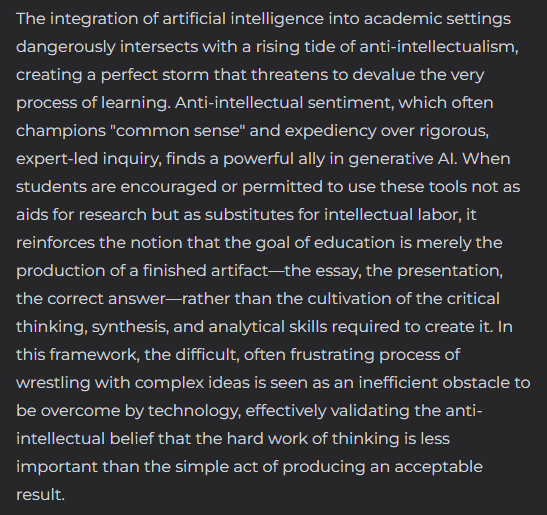
I don’t know how to feel about the fact that Gemini managed to articulate my sentiment better than I did, but if anything, this supports my argument that having something else “think” for you just dumbs you down. While I honestly haven’t ever used AI for notes, outlining, basically anything outside of our class on Philosophy and AI, my lack of eloquence in writing is a result of my struggles of procrastination, and furthermore my practice in writing being less than ideal at the moment. While this isn’t meant to be a moment of me saying “it was all intentional”, it does still support the fact that practice is crucial to developing such skills. We need to be competent in our reading, speaking, writing, and critical thinking, a need that goes far beyond the purpose of performing well in school.
Political Implications
Anti-Intellectualism can be expressed in many forms. A contemporary example of this would be in the Anti-Vax movement, known for outwardly denying the credibility of experts in the medical and scientific field in relation to the necessity of vaccinations. This movement has spread misinformation on pseudoscience studies which have been disproven since their publication, such as the 1990s research paper linking vaccines to autism. Despite the research having been determined to utilize fake data and suggest a connection so overwhelmingly incorrect, followers of the Anti-Vax movement may continue to utilize the publication to argue for their cause. Any criticism of their sources is found quickly excused by conspiracy theories and such. In this example, the facts are no longer facts.
Another example of anti-intellectualism can be found in the adverse reaction certain people have towards the topics of DEI and “wokeness”, both of which are dumbed down to being part of a radical agenda that prioritizes “undeserving” members in our community. Those against DEI won’t ever say the words that the acronym stands for (diversity, equity, inclusion) because it then highlights how strange it is to be against such values. Planting this seed of doubt about DEI allowing the jobs of credible cishet men to be “stolen” by women, people of color, and other historically marginalized groups has only worsened our current issues of not being able to agree on what we accept to be factual. On the subject of “wokeness”, here is a press release from the United States Department of Education. Nowadays, the word “woke” has been spun to refer to anything considered to be too radical, such as DEI, Critical Race Theory, and so on. The Department of Education is implying in this release that such programs, which supported a significant number of disadvantaged Americans in the educational and labor fields, were a waste of money.